

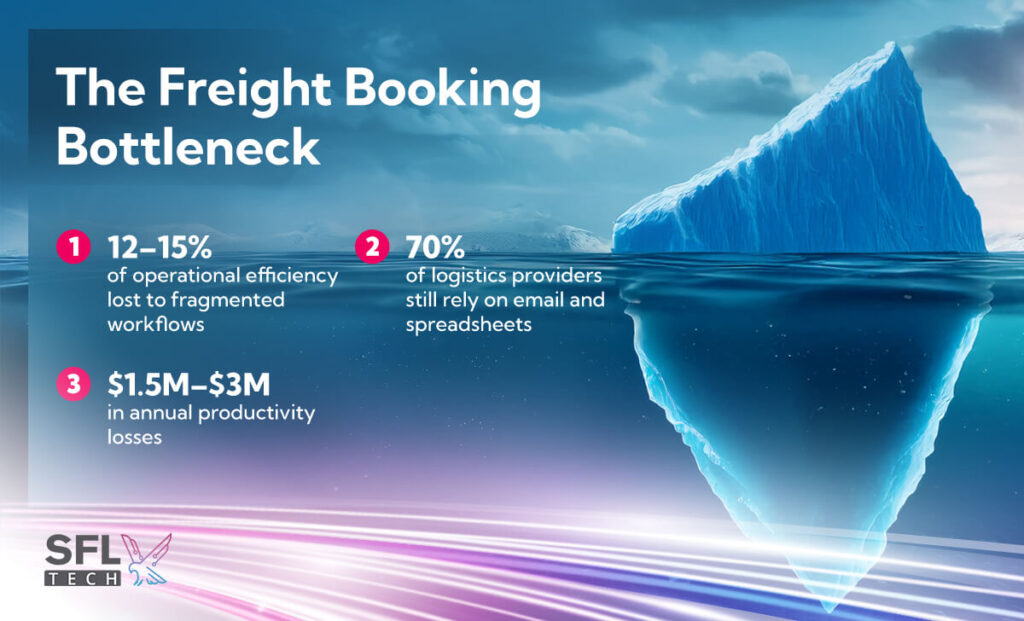
Ocean freight booking is the heartbeat of global logistics—and it’s under strain. Despite billions spent on digital transformation, automation, analytics, and AI to drive efficiency and scale. But there’s one function that continues to quietly sabotage progress: freight booking. It’s the moment where customer demand becomes operational execution. And it’s still broken. External platforms don’t talk to internal systems. Teams chase confirmations. Data gets re-entered. Visibility disappears. According to a 2024 McKinsey study, logistics providers lose an average of 12–15% of operational efficiency due to fragmented booking workflows. That’s not just inefficiency—it’s lost revenue, strained teams, and frustrated customers. Freight booking, arguably the most critical link between shippers, carriers, and logistics providers has become a bottleneck. And in a market where agility, accuracy, and speed are non-negotiable, that bottleneck is costing companies their competitive edge.
- According to McKinsey, manual booking processes contribute to up to 30% of operational delays in logistics.
- Gartner reports that over 70% of logistics providers still rely on email and spreadsheets for booking coordination.
- And Accenture estimates that poor booking integration can cost $1.5M–$3M annually in lost productivity for mid-sized logistics firms.
- This isn’t just inefficient. It’s a strategic liability.
The Real Cost of Doing Nothing
Let’s be clear: this isn’t just a technical inconvenience. It’s a strategic risk.
Manual bookings introduce error rates of up to 30%,
Customer onboarding can take days or even weeks, delaying revenue capture.
Lack of real-time visibility leads to missed SLAs, compliance issues, and reputational damage.
And the pressure is mounting. Customers now expect instant confirmations, digital onboarding, and real-time updates. Regulatory bodies demand auditable, accurate data. And the market? It rewards those who can move fast, scale smart, and adapt instantly.
The SFL Tech Response: A Framework Built for What’s Next
At SFL Tech, we engineered a transformation framework. Our scalable EDI integration framework is designed to:
- Automate the entire booking lifecycle—from request to confirmation
- Synchronise data across platforms and systems in real time
- Eliminate manual touchpoints, reducing errors and freeing up human capital
- Accelerate onboarding, so new customers are live in hours, not days
- Scale effortlessly as your business grows and diversifies
This isn’t a plug-and-play tool. It’s a modular, extensible architecture that adapts to your environment—whether you’re a regional carrier or a global logistics powerhouse.
Inside the Framework: Built for Scale, Engineered for Precision
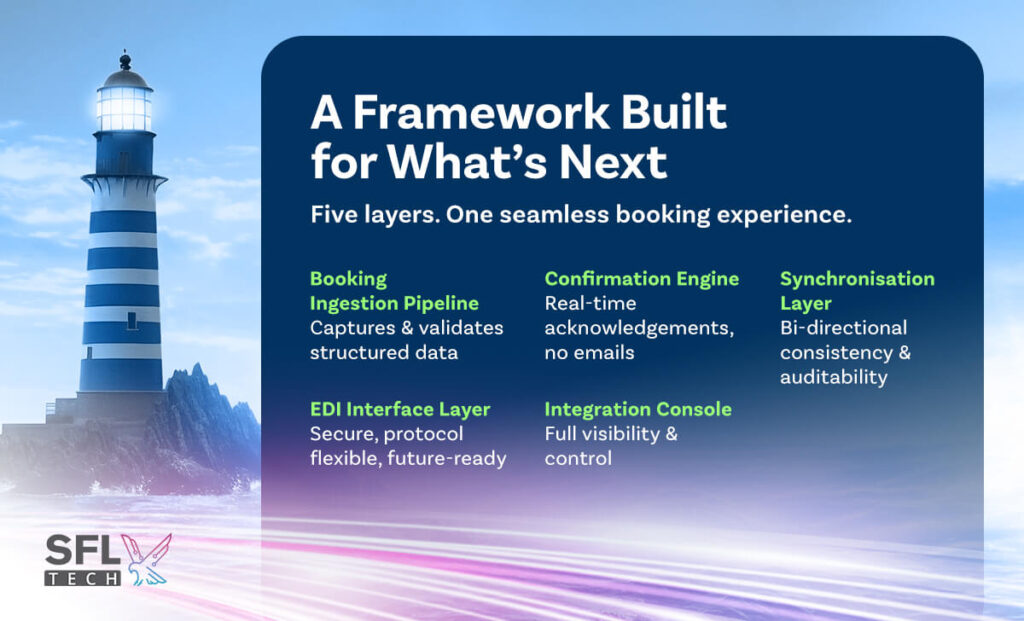
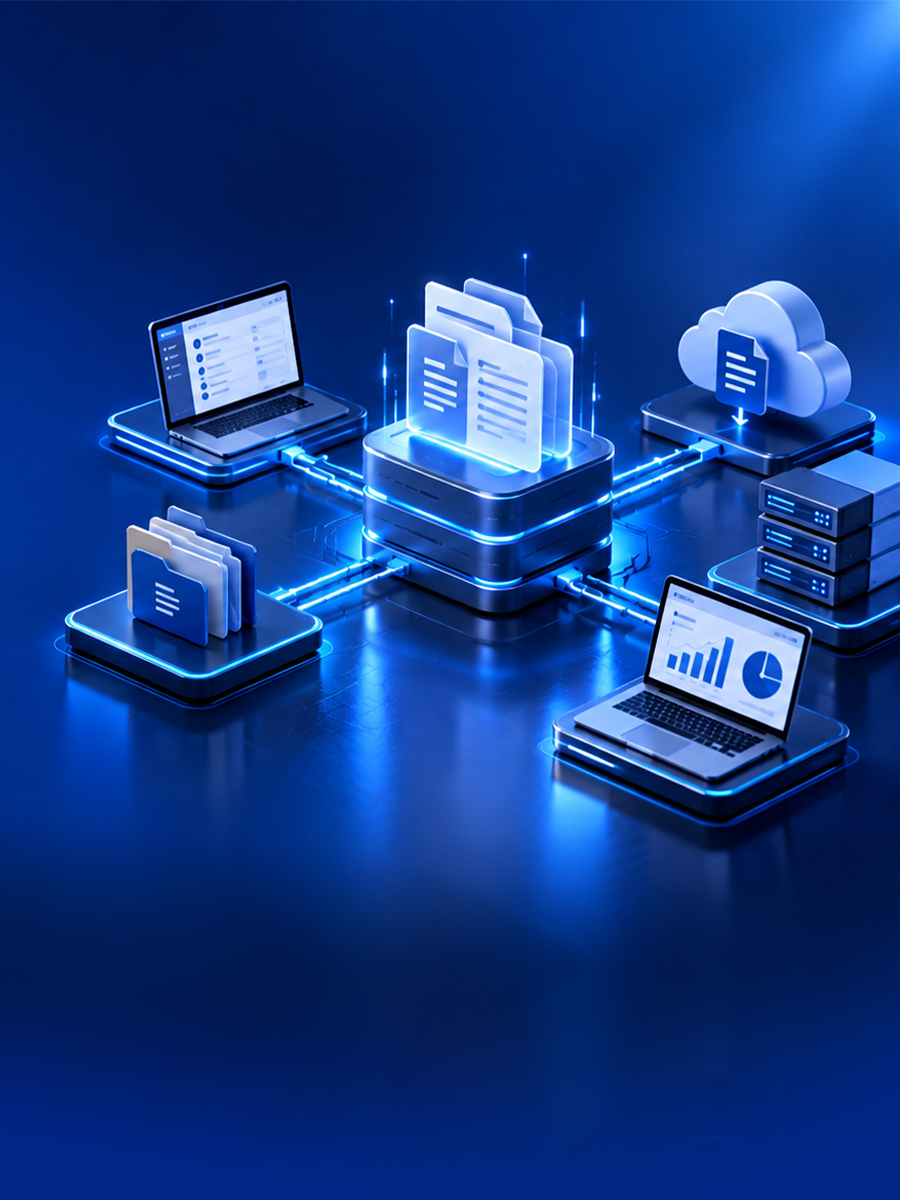
Our architecture is composed of five tightly integrated layers:
- Booking Ingestion Pipeline Captures structured booking data from external platforms using standardised formats (e.g., IFTMBF), validates it, and feeds it directly into your TMS.
- Confirmation Engine Generates real-time acknowledgements (e.g., IFTMBC) and closes the booking loop—without a single email or spreadsheet.
- Synchronisation Layer Maintains bi-directional data consistency, detects errors, and ensures auditability across systems.
- EDI Interface Layer Secure, protocol-flexible (AS2, FTP, API), and future-ready for new message types and partners.
- Integration Management Console Gives your team full visibility into message flows, errors, and performance—so nothing falls through the cracks.
From Blueprint to Business Value: Our Implementation Journey
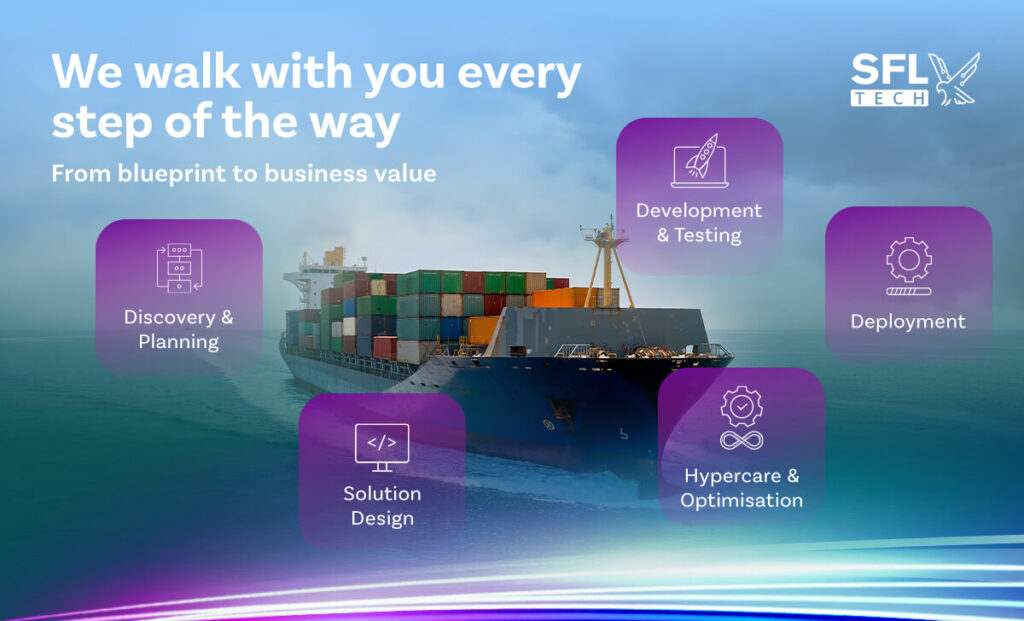
We don’t just drop in a solutio, we walk with you through every phase:
- Discovery & Planning: We map your workflows, identify friction points, and define success metrics.
- Solution Design: We architect the integration logic to fit your business—not the other way around.
- Development & Testing: We build, test, and validate with real-world scenarios.
- Deployment: We roll out in controlled phases, ensuring adoption and stability.
- Hypercare & Optimisation: We fine-tune, expand, and future-proof your integration.
The Results: What Transformation Looks Like
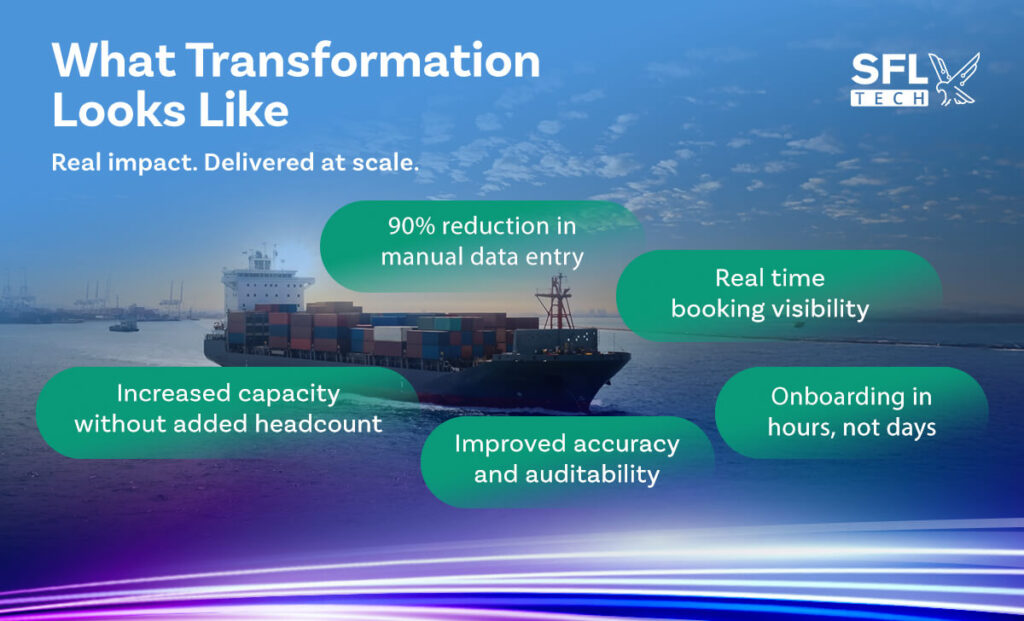
This framework has already delivered measurable impact in high-volume logistics environments:
- 90% reduction in manual data entry
- Real-time booking visibility across systems
- Faster turnaround times for confirmations
- Customer onboarding reduced from days to hours
- Improved data accuracy and auditability
- Increased operational capacity without increasing headcount
These aren’t projections. These are outcomes delivered by SFL Tech, in the field, at scale.
The Strategic Payoff
Digitizing freight bookings isn’t just about doing things faster—it’s about doing business better.
- Expand your commercial reach with digital-first customer engagement
- Capture revenue faster with streamlined onboarding and booking flows
- Elevate your brand as a digitally connected logistics partner
- Future-proof your infrastructure for new platforms, partners, and business models
In a market where digital convenience is a differentiator, this framework positions your business to lead.
Why SFL Tech
We’re not just technologists, we’re logistics insiders. We understand the operational grind, the system intricacies, and the strategic stakes.
- Deep expertise in TMS and EDI protocols
- Experience across diverse booking platforms and message standards
- Custom integration logic tailored to your business rules
- Proven delivery in complex, high-volume environments
The Future Is Integrated. Are You Ready?
The freight booking process of the future is automated, intelligent, and invisible. No more delays. No more errors. Just seamless, scalable operations that let your team focus on what matters—growth, service, and innovation. Let’s build that future together.
.png)


.png)

.png)






.png)
.png)



.png)




.png)



















.png)












.png)











.png)



.png)